Easily the most contentious performance I’ve witnessed since Young Jean Lee’s The Shipment—which played the same house last March—EMPIRE (Art & Politics), at the MCA Stage October 2 and 3, has stewed restlessly in the minds of everyone I know who’s seen it. Reductively assessed, it’s a snowballing extrapolation of two early lines: In voiceover while we take in four opening tableaux—two of which are a bare-breasted woman hoisting a French flag and a couple playing cards*—actor Davis Freeman thunders, “What’s the secret behind this card game? What lies are being told that will never make it into our history books?” Moments later, that couple, dressed in gorgeous Napoleonic era costumes by Sabine Debonnets and Odile Hautemulle, ends their game, the woman victorious.
“I won,” she says contentedly, putting down her hand. “Now: What shall it be?”
The remaining hour and a half of European performance collective Superamas’s latest show suggests that this woman, like the winner of any battle, epic or tiny, can choose anything she wants.
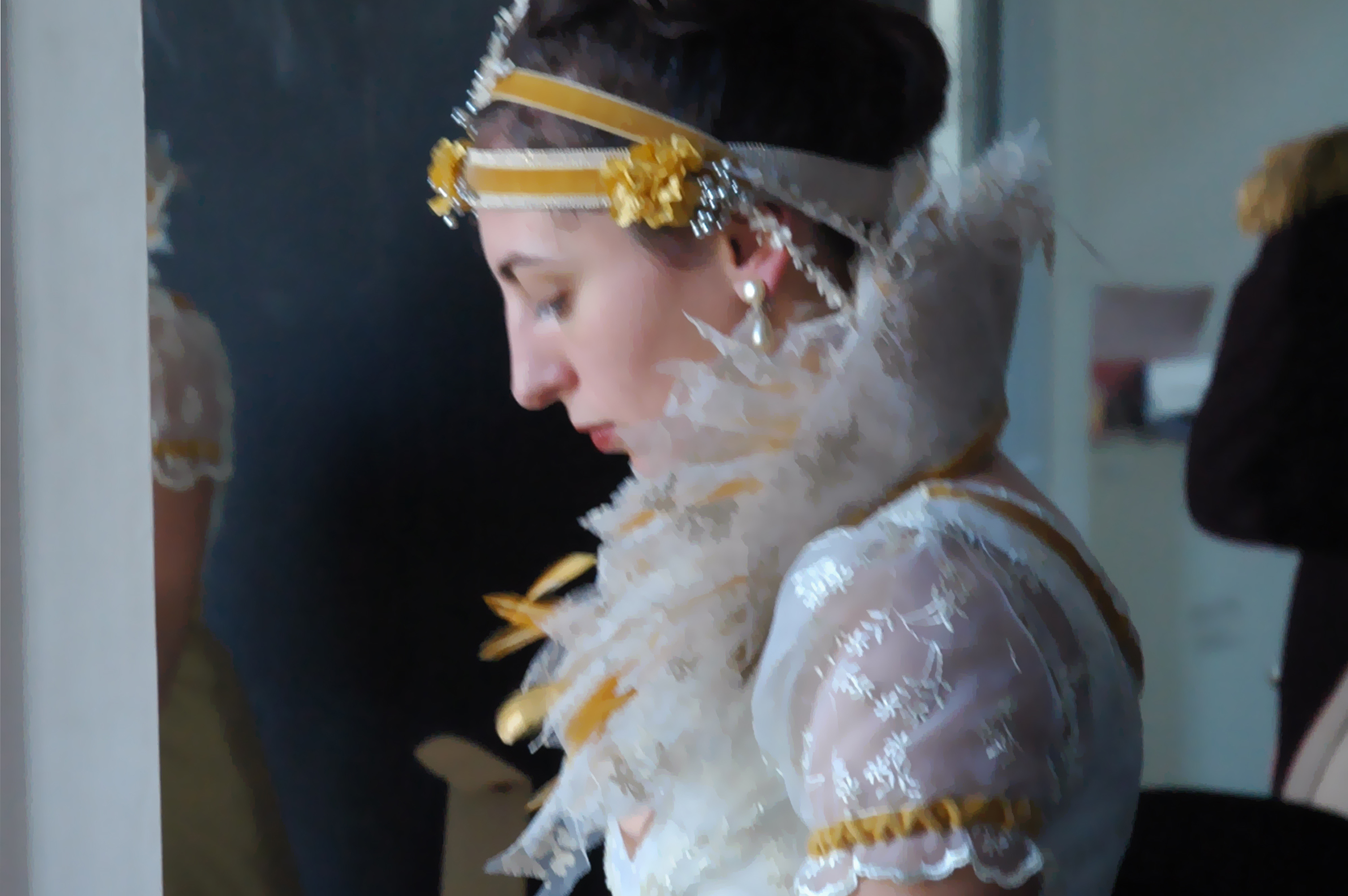
Photo by Giannina Urmeneta Ottiker, courtesy the Museum of Contemporary Art.
Through cinematic use of lighting and sound effects, a deranged and slapstick, Cliffs Notes reenactment of the Battle of Aspern-Essling follows. In one short scene, a black soldier is humiliated with racist jokes (his captors dance around like monkeys), then executed by firing squad. Another begins with a torrid but consensual three-way tryst which, when interrupted, becomes a hideously cartoonish pair of rapes. Later, all the soldiers die, one by one, until the stage is littered with bodies. (Some of this is soundtracked with Wagner and Offenbach, some of it by Godspeed You! Black Emperor and Michael Jackson). Enter a movie camera on a motorized dolly, recording the carnage with a floodlight to Patti Smith’s cover of “Pastime Paradise.”
It’s a film set, you see, and the actors soon reappear, freshened up in elegant contemporary clothes (also gorgeous, by Alix Eynaudi) to mingle, and celebrate the production with some sabered Champagne at a party for unappealing people. One is a naïve, privileged college student and daughter of the host, a smug and self-satisfied, flirtatious French ambassador named Philippe Dupraz. Innocuous tropical lounge music plays, what you hear in the lobby of a W Hotel, but the fête’s mood is threatened when a token guest, a political refugee, recounts terrible tales of the Somali turmoil that keeps him from his homeland and what remains of his family. The gravity of his story is hastily ignored, or whitewashed by the others’ transparent lack of ability (and willingness) to relate.
Giant light fixtures, white globes suggesting planets given monochromatic paint jobs, hover motionless over the action. The camera remains always, flanked by a sound technician wielding a boom microphone. (Three or four conversations might happen simultaneously, but only one at a time is chosen for the record. What lies are being told that will never make it into our history books? Also, this skeleton camera crew can interact with Freeman’s American character while the rest of the cast is caught in a freeze frame. In more than one respect, a quote by David Lynch does not come from nowhere, and there’s a healthy splash of Cronenberg in there, too.) Read More…

 trailerpilot